
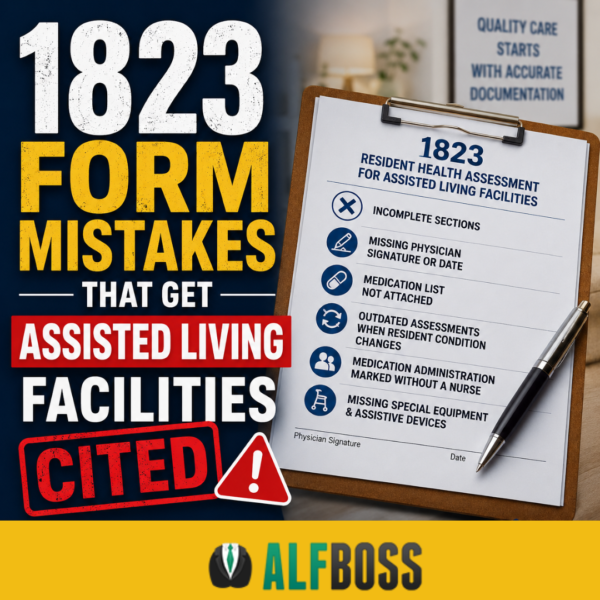
1823 Form Mistakes That Get Assisted Living Facilities Cited
If there’s one document that consistently causes deficiencies during AHCA surveys, it’s the Resident Health Assessment for Assisted Living Facilities (Form 1823).
Many administrators focus on medication records, training documentation, and service plans, but overlook the importance of keeping Form 1823 accurate and up to date. Unfortunately, surveyors review these forms closely, and even a small mistake can result in a citation.
Let’s review some of the most common 1823 form mistakes that lead to deficiencies in assisted living facilities.
1. Incomplete Sections on the 1823 Form
One of the most common reasons facilities receive citations is simply because information is missing.
Every section of the 1823 must be completed correctly. If a diagnosis is missing, a required field is left blank, or information is incomplete, surveyors may cite the facility.
Common examples include:
- Missing diagnoses
- Incomplete assessment sections
- Blank fields left unanswered
- Missing physician information
The 1823 should always be reviewed carefully before it is placed in the resident’s file.
2. Missing Physician Signature or Date
Another frequent deficiency occurs when the physician does not properly complete the form.
Facilities often receive an 1823 that appears complete, only to discover later that:
- The physician forgot to sign the form
- The physician forgot to date the form
- Provider information is incomplete
Even though the facility did not create the error, the facility is still responsible for ensuring the document is complete before accepting it.
Always review every page before filing the assessment.
3. Medication List Not Attached
The resident’s medication list should accompany 1823.
If surveyors review the record and the medication list is missing, the facility may receive a deficiency.
A complete resident record should clearly identify:
- Current medications
- Dosages
- Administration instructions
- Any related physician orders
Keeping the medication information attached and current helps ensure compliance and continuity of care.
4. Failure to Update the 1823 When a Resident’s Condition Changes
One of the biggest mistakes facilities make is treating the 1823 as a one-time document.
Residents change over time, and 1823 must reflect those changes.
Examples include:
- Resident begins hospice services
- Resident requires assistance with transfers
- Resident starts oxygen therapy
- Resident experiences a significant decline in condition
- Resident develops new care needs
If the resident’s current condition does not match what is documented on the 1823, surveyors may determine that the assessment is no longer accurate.
5. Not Reviewing Physician Responses Carefully
Many facilities assume the physician completed the form correctly and file it without review.
This can create serious compliance issues.
For example, a physician may indicate that the resident requires medication administration. If your facility does not have a licensed nurse available to provide medication administration, this could create a compliance problem.
Similarly, a physician may indicate that a resident requires 24-hour psychiatric care or another level of care that exceeds what the facility is licensed to provide.
These responses must be reviewed immediately so that any concerns can be addressed before they become survey deficiencies.
6. Missing Special Equipment and Assistive Devices
Another commonly overlooked section involves assistive devices and special equipment.
The 1823 should accurately reflect equipment the resident uses, including:
- Walkers
- Wheelchairs
- Canes
- Oxygen equipment
- Air mattresses
- Other medical support devices
In some situations, bed rails may also need to be addressed appropriately on the assessment, depending on the resident’s circumstances and facility policies.
Surveyors expect the assessment to accurately reflect the resident’s current care needs and equipment usage.
The Big Picture: The 1823 Is the Resident’s Roadmap
The most important concept administrators should understand is that 1823 serves as a roadmap of the residents.
A person reviewing the form should be able to quickly understand:
- The resident’s current condition
- The care and supervision required
- Functional limitations
- Medical needs
- Equipment and assistive devices being used
When the information on the 1823 does not match the resident’s actual condition, deficiencies become much more likely.
Final Thoughts
Maintaining accurate 1823 forms requires ongoing attention. Residents’ conditions change, care needs evolve, and documentation must keep pace.
Before your next survey, conduct a thorough review of all resident 1823 forms and verify that:
- Every section is complete
- Physician signatures and dates are present
- Medication lists are attached
- Resident condition changes are documented
- Assistive devices are accurately recorded
- The assessment reflects the resident’s current status
A few minutes spent reviewing an 1823 today could help your facility avoid a costly deficiency tomorrow.
Need help preparing for an AHCA survey? ALF Boss helps assisted living facilities with compliance, training, consulting, and survey readiness throughout Florida.