
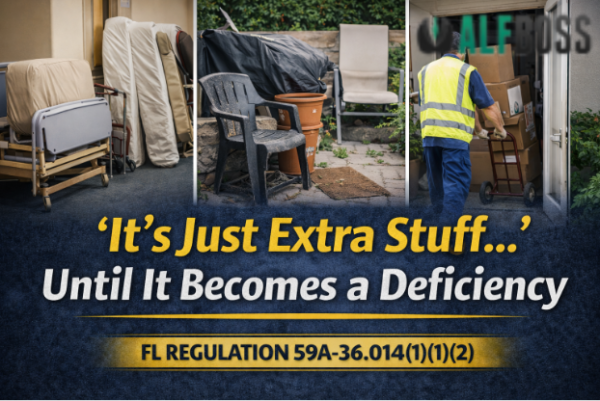
“It’s Just Extra Stuff…” Until It Becomes a Deficiency
Florida Regulation
59A-36.014(1)(1)(2)
– Physical Plant Standards & Hazard-Free Environments
Walk your building for five minutes…
and you’ll see it.
An extra bed leaning against the wall.
Boxes stacked in a corner.
Old equipment sitting “temporarily” in a hallway.
And don’t forget outside…
Broken chairs in the courtyard.
Unused equipment on patios.
Storage creeping into outdoor seating areas.
No one thinks it’s a big deal.
Until survey walks in.
Under 59A-36.014, this is exactly what they’re looking for.
What the Regulation Requires
Your facility must:
- Provide a safe living environment (per Section 429.28(1)(a), F.S.)
- Be maintained free of hazards
This applies to the entire environment—not just inside the building.
The Reality in Facilities
Space gets tight.
Deliveries come in.
Old equipment gets replaced.
And instead of being removed or properly stored…
it gets pushed to the side “for now.”
That “for now” turns into:
- Extra beds in resident areas
- Broken equipment sitting in corners
- Boxes in hallways
- Storage in common areas
- Outdoor clutter in courtyards and patios
Now your facility is no longer hazard-free—inside or outside.
Courtyards and Outdoor Areas Count Too
A lot of facilities overlook this.
If residents have access to:
- Courtyards
- Patios
- Outdoor walkways
- Garden areas
👉 Those areas must also be:
- Free of hazards
- Clear of clutter
- Safe for resident use
Common Outdoor Issues:
- Stored furniture or broken chairs
- Maintenance items left out
- Uneven walkways not addressed
- Equipment placed in corners “temporarily”
Surveyors don’t separate indoor vs outdoor.
If residents can access it—it must be safe.
Why Surveyors Take This Seriously
This isn’t about appearance.
This is about:
- Fall risks
- Blocked pathways
- Emergency access issues
- Resident safety in all environments
Inside or outside, the expectation is the same:
Safe. Clear. Hazard-free.
The Most Common Citation Scenario
Survey walks through your building and then steps outside…
They see:
- Items stored in hallways
- Equipment accessible to residents
- Clutter in courtyards or patios
They don’t ask why.
They cite the facility for:
Failure to maintain a hazard-free environment.
The Big Mistake
Thinking:
“We just don’t have the space.”
or
“It’s outside, it’s fine.”
Neither holds up.
The regulation doesn’t make exceptions.
What You Should Be Doing Instead
1. Remove It or Store It Properly
If it’s not being used:
- Move it to a designated storage area
or - Remove it from the property
2. Keep ALL Resident Areas Clear
That includes:
- Hallways
- Common areas
- Bedrooms
- Courtyards and outdoor spaces
If residents can access it, it must be clear.
3. Walk Your Entire Property Daily
Not just inside.
- Walk hallways
- Check corners
- Step outside into courtyards and patios
Look at everything the way a surveyor would.
4. Train Your Staff
Staff should understand:
- “Temporary storage” is not allowed anywhere residents have access
- Indoor or outdoor—it doesn’t matter
- Safety standards apply to the full environment
Administrator Insight
This regulation exposes discipline.
A clean building and courtyard show:
- Attention to detail
- Strong leadership
- Consistent systems
Clutter—inside or outside—shows:
- Things are being overlooked
- Standards are slipping
- No one is taking ownership
And once survey sees that…
they go deeper.
Quick Compliance Check
- Any unused items in resident-accessible areas?
- Hallways completely clear?
- Equipment stored properly?
- Courtyards and patios free of clutter?
- Would your entire property pass a surprise walkthrough?
Final Thought
This isn’t about space.
It’s about control.
That extra bed inside…
that broken chair outside…
that “temporary” storage in the courtyard…
It all counts.