
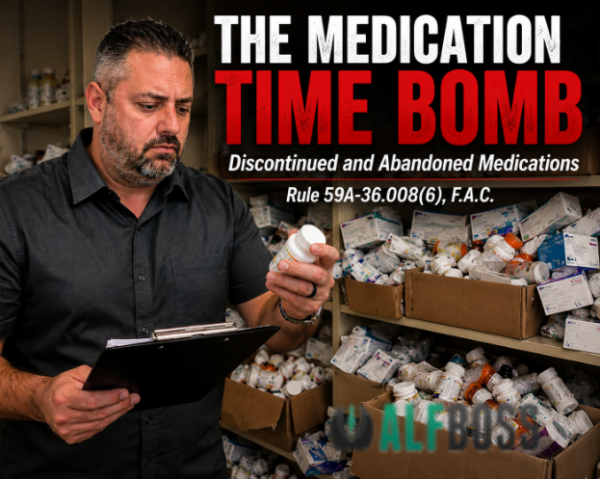
The Medication Time Bomb Sitting in Your Facility
Rule 59A-36.008(6), F.A.C. – Medication Practices
One of the questions I routinely ask during a mock survey is:
“Where do you keep discontinued medications and medications left behind by discharged residents?”
More often than not, someone opens a cabinet, closet, drawer, or storage room and I am shocked by what I find.
Bottles and boxes of medications.
Cabinets full of medications.
Sometimes medications from residents who left months ago.
Unfortunately, this is an AHCA deficiency that continues to show up in assisted living facilities across Florida.
Many administrators and medication technicians are unaware that there are very specific requirements regarding the handling, storage, return, and disposal of unused medications. What may seem like a harmless oversight can quickly become a survey citation.
Why AHCA Takes This Seriously
When surveyors discover discontinued or abandoned medications sitting in a facility, they have no way of knowing what has happened to those medications.
Have they been sitting untouched?
Have they been administered to the wrong resident?
Could they have been diverted by staff?
Because of these concerns, AHCA closely examines medication storage areas during surveys.
Remember, AHCA has broad authority to inspect your facility.
Under Section 408.811, Florida Statutes, surveyors may inspect any area necessary to determine compliance, including:
- Medication carts
- Locked medication rooms
- Storage closets
- Locked cabinets
- Sealed boxes
- Any other area where medications may be stored
Simply placing medications in a box and putting tape over it does not remove them from AHCA’s view.
What the Regulation Requires
Discontinued Medications
According to Rule 59A-36.008(6)(d), F.A.C., medications that have been discontinued but have not expired must be:
- Returned to the resident or resident representative; or
- Stored separately for future use by that same resident if requested.
If the facility centrally stores discontinued medications, they must:
- Be stored separately from current medications.
- Be kept in a designated area.
- Be clearly marked “Discontinued Medication.”
These medications may only be reused if later prescribed again for that same resident.
Medications After Discharge
According to Rule 59A-36.008(6)(e), F.A.C., when a resident leaves the facility, the administrator must return all remaining medications to:
- The resident,
- The resident’s family, or
- The resident’s guardian.
If the facility notifies the responsible party and the medications remain unclaimed for at least 15 days, the medications are considered abandoned.
Disposal Requirements
Rule 59A-36.008(6)(f), F.A.C. requires abandoned or expired medications to be disposed of within 30 days.
The disposal must be documented in the resident’s record.
Medications may be:
- Taken to a pharmacist for disposal; or
- Destroyed by the administrator or designee in the presence of one witness.
Action Steps to Stay Compliant
1. Audit Your Medication Storage Areas
Open every drawer, cabinet, closet, and storage box.
Look specifically for:
- Discontinued medications
- Expired medications
- Medications belonging to discharged residents
2. Create a Tracking Process
Develop a system for documenting:
- Date of discharge
- Date the family was notified
- Date medications were picked up
- Date medications were determined abandoned
- Date medications were disposed of
3. Review Your Policies and Procedures
Your facility should have a written policy addressing:
- Discontinued medications
- Medication returns
- Medication disposal
- Documentation requirements
4. Train Medication Staff
Medication technicians and administrators should understand exactly what to do when:
- A physician discontinues a medication
- A resident is discharged
- Medications become expired
- Medications are abandoned
If AHCA opens a cabinet in your facility and discovers medications from residents who moved out months ago, it raises immediate concerns.
The good news is that this deficiency is completely preventable.
Build a system.
Perform routine audits.
Dispose of medications properly.
And make sure every member of your medication team understands the requirements of Rule 59A-36.008(6), F.A.C.