
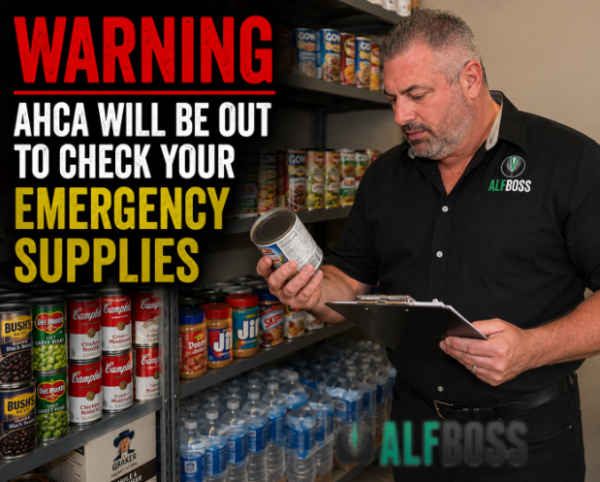
HURRICANE SEASON IS HERE…
Is Your Emergency Food Supply Ready for an AHCA Survey?
Every summer, assisted living facilities across Florida begin preparing for hurricane season.
And every summer, AHCA surveyors begin taking a closer look at two things:
- Your generator
- Your emergency food and water supply
During mock surveys, one of the most common issues I find is facilities that either do not have enough emergency supplies on hand or have supplies that have expired and have not been replaced.
The reality is simple:
Having emergency food and water is not just a regulatory requirement.
It is a resident safety issue.
What AHCA Requires
According to AHCA guidance under ST-A0093 – Food Service – Dietary Standards, facilities must maintain:
A 3-day supply of nonperishable food, based on the number of weekly meals the facility has contracted with residents to serve, must be on hand at all times.
The quantity must be based on your current resident census, not your licensed capacity.
The food supply must:
- Be nonperishable
- Be safely stored without refrigeration
- Be readily accessible during an emergency
Facilities must also have sufficient water for drinking and food preparation or have an approved emergency plan for obtaining water that has been coordinated with local emergency management officials.
The Biggest Mistake Facilities Make
Many facilities purchase emergency supplies, place them in storage, and forget about them.
Months later, or even years later, AHCA opens the emergency supply closet and discovers:
- Expired food
- Missing inventory
- Opened packages
- Insufficient quantities
- No tracking system
At that point, it doesn’t matter that the facility purchased the supplies.
The facility is responsible for ensuring those supplies remain available and usable.
The System AHCA Wants To See
The facilities that consistently stay compliant have a simple system.
Maintain an Emergency Supply Inventory
Your inventory should include:
- Item description
- Quantity
- Purchase date
- Expiration date
- Storage location
This allows you to quickly identify items approaching expiration.
Conduct Regular Audits
At a minimum, perform a quarterly review of all emergency food supplies.
During the audit:
- Verify quantities
- Check expiration dates
- Inspect packaging for damage
- Confirm inventory matches actual supplies
Rotate Supplies Before They Expire
One of the easiest systems is to move items that are nearing expiration into your regular kitchen inventory and replace them immediately with new products.
This helps reduce waste while keeping your emergency stock current.
Replace Used Items Immediately
If an emergency supply item is opened or used for any reason, replace it immediately.
Emergency supplies should always remain complete and ready for use.
Don’t Forget the Water
Food is only part of the equation.
The Florida Division of Emergency Management recommends maintaining at least:
One gallon of water per person, per day, for three days.
That includes residents and staff who may be sheltering in place during an emergency.
During mock surveys, I often ask:
“Show me your emergency water supply.”
You should know exactly where it is and be able to demonstrate that you have enough.
Action Steps
Review Your Emergency Food Inventory
Verify quantities based on your current resident census.
Check Expiration Dates
Remove and replace expired items immediately.
Verify Your Water Supply
Make sure you have adequate water for residents and staff.
Test Your System
Ask yourself:
If AHCA arrived today and asked to see your emergency food and water supply, would you be ready?
Hurricane season is not the time to discover that your emergency supplies are expired, incomplete, or missing.
The facilities that perform well during emergency preparedness reviews don’t wait for AHCA to ask questions.
They already have a system.
And when the next storm approaches, both the facility and its residents benefit from that preparation.