
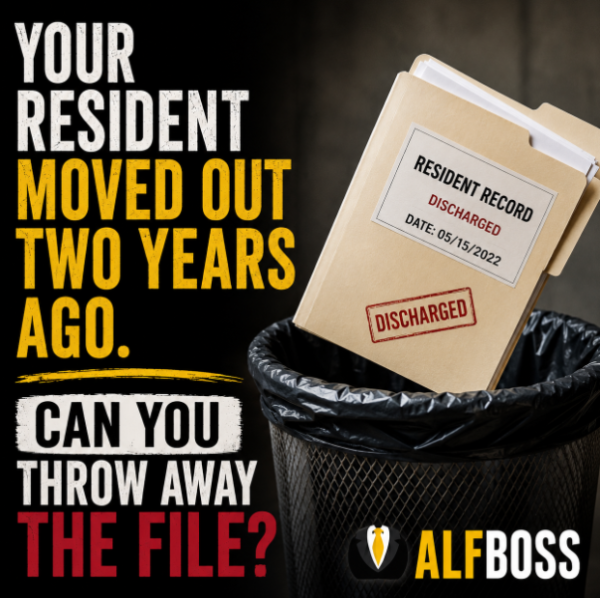
YOUR RESIDENT MOVED OUT TWO YEARS AGO. CAN YOU THROW AWAY THE FILE?
Florida ALF Resident Record Retention Requirements Every Operator Should Know
A resident moves out of your assisted living facility.
Their room gets filled. Their chart gets moved into storage. Time passes.
Then, a couple of years later, someone cleaning out the filing cabinets asks:
“Can we finally throw this file away?”
The answer isn’t automatically yes.
Florida assisted living regulations establish specific requirements for how long resident records must be retained after a resident leaves the facility.
And there is one important difference every administrator should know:
Most resident records must be retained for 2 years after the resident leaves.
Resident contracts must be retained for 5 years.
Let’s look at what the regulation actually requires.
What Does the Regulation Require?
Rule 59A-36.015(3)(q), F.A.C. — Records
Florida’s assisted living regulations require facilities to retain:
All resident records for 2 years following the departure of the resident from the facility.
However, there is an important exception:
Resident contracts must be retained for 5 years.
The regulation also requires records to be retained longer when the facility’s contract requires a longer retention period.
That means you shouldn’t automatically destroy an entire resident file simply because two years have passed.
The Two-Year Clock Starts When the Resident Leaves
Pay attention to the wording of the regulation.
The requirement is to retain resident records for:
2 years following the departure of the resident from the facility.
The retention period is therefore tied to the resident’s departure date.
For example, if a resident leaves your facility on August 15, 2026, that departure date becomes important when determining when the applicable two-year record-retention period has been satisfied.
This is why every former resident’s file should have a clearly documented departure date.
Don’t Accidentally Destroy the Resident Contract
This is probably one of the easiest mistakes to make.
You have a former resident’s chart sitting in storage.
Two years have passed.
Someone sees the date and says:
“It’s been two years. We can shred it.”
Not so fast.
The resident contract has a different retention requirement.
Resident contracts must be retained for 5 years.
If your facility destroys eligible resident records after the required two-year period, you need a system to ensure the resident contract isn’t accidentally destroyed along with everything else.
Simply shredding the entire chart at the two-year mark could create a record-retention problem.
Your Own Contract Could Require You to Keep Records Longer
There’s another important part of the regulation that shouldn’t be overlooked.
The rule requires records to be retained longer if the facility’s contract requires a longer retention period.
That’s why your facility’s record-retention policy should match what your resident contract actually says.
You don’t want your internal policy saying:
“Destroy resident records after two years.”
while your own resident contract requires something different.
Before establishing a destruction schedule, review your resident contract.
What If the Resident Wants Their Records When They Leave?
Rule 59A-36.015 also addresses this.
Upon request, a resident must be provided with a copy of their records upon departure from the facility.
The important word here is:
COPY.
Giving a departing resident copies of their records doesn’t eliminate the facility’s responsibility to retain its required records for the applicable retention period.
Former Resident Records Still Need to Be Accessible
Archived doesn’t mean forgotten.
Rule 59A-36.015 requires facility records to be maintained so they are readily available for review by legally authorized entities.
If your facility maintains records electronically, staff must be able to access the data and produce the requested information.
The regulation defines “readily available” as the ability to immediately produce the requested documents or data, electronically or in paper form, upon request.
That’s something facilities using electronic records should pay particular attention to.
A former resident’s records shouldn’t disappear into:
- An old computer
- An inactive software account
- An old cloud-storage folder
- A filing system nobody understands
- A storage box nobody can locate
If you’re required to maintain the record, you should also have a system for retrieving it.
Who Can Access Resident Records?
Keeping a former resident’s records doesn’t mean you can release them to anyone who asks.
Rule 59A-36.015 identifies individuals who may have authorized access to resident records, including the resident and, as applicable, the resident’s legal representative, designee, surrogate, guardian, attorney in fact, case manager, estate, and other parties authorized in writing or by law.
Your facility should therefore have a process for both:
Retaining the record
and
Determining who is authorized to receive it.
Create a Retention Date for Every Resident Who Leaves
Here’s a simple compliance system I recommend.
When a resident leaves your facility, don’t simply write:
DISCHARGED
Document:
Resident Departure Date: __________
2-Year Resident Record Retention Date: __________
5-Year Resident Contract Retention Date: __________
Location of Archived Record: __________
If you’re using electronic records, your system should accomplish the same thing.
This removes the guesswork years later when someone is cleaning out old files.
Be Careful With the Annual “File Purge”
I understand why facilities do this.
File cabinets get full.
Storage rooms fill with boxes.
Old resident charts start piling up.
Eventually somebody says:
“We need to get rid of these old files.”
There’s nothing wrong with having an organized record-destruction process.
The problem is destroying records based solely on how old the box looks.
Before destroying a former resident’s records, verify:
- The resident’s actual departure date
- Whether the required two-year retention period has been satisfied
- Whether the resident contract has been identified and retained for the required five years
- Whether your resident contract requires a longer retention period
Don’t have someone standing next to a shredder guessing which resident files are old enough to destroy.
Create a system.
Compliance Tip: Maintain a Former Resident Retention Log
Consider maintaining a simple former-resident record-retention log.
For every resident who leaves, track the resident’s departure date, the location of the archived record, the applicable two-year retention date, and the five-year contract retention date.
Then periodically review the log to determine which records have reached their applicable retention period.
This is much safer than trying to figure everything out several years later.
The Bottom Line
Under Rule 59A-36.015(3)(q), Florida Administrative Code:
Resident records must be retained for 2 years following the resident’s departure from the facility.
Resident contracts must be retained for 5 years.
Records must be retained longer if required by the facility’s contract.
And upon request, a resident must be provided with a copy of their records when they leave the facility.
59A-36.doc
So the next time someone asks:
“THE RESIDENT MOVED OUT TWO YEARS AGO. CAN I THROW AWAY THE FILE?”
Don’t automatically say yes.
Check the departure date. Check the contract. Check what you’re about to destroy.
A simple record-retention system can prevent an unnecessary compliance problem.
Regulation Referenced:
Rule 59A-36.015(3)(q), Florida Administrative Code — Records