
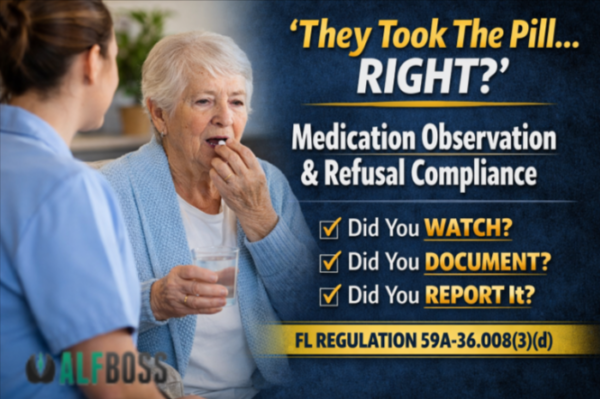
“They Took the Pill… Right?”
Florida Regulation
59A-36.008(3)(d)
– Observation & Medication Refusals That Turn Into Deficiencies
In assisted living, one of the most common survey issues comes down to a simple moment:
Staff hands the medication…
…and walks away.
That one habit alone can trigger a deficiency under 59A-36.008(3)(d).
What the Regulation Actually Requires
When assisting with self-administration:
- Staff must observe the resident take the medication
- Any concerns must be:
- Reported to the health care provider
- Documented in the resident record
This is not about passing meds.
This is about verifying ingestion and responding to issues.
Where Facilities Get It Wrong
This is what surveyors see all the time:
- Meds handed off without observation
- Staff assuming compliance
- Refusals documented with no follow-up
- No provider notification
- No system for tracking patterns
Then the surveyor asks:
“How do you know the medication was taken?”
If your answer is “staff gave it”… that’s not enough.
Medication Refusals: A Compliance Trigger
A refusal is not just a documentation event—it’s a clinical and regulatory event.
What needs to happen:
- Document the refusal clearly
- Monitor for repeated refusals
- Notify the provider when appropriate
If a resident refuses medication multiple times and nothing changes,
that becomes your responsibility—not the resident’s choice.
Practical System to Stay Compliant
Create a simple internal protocol your staff can follow:
- 1st refusal: Document
- 2nd refusal: Flag for review
- Ongoing refusals: Notify provider and document response
This shows surveyors you are not just recording problems—you are managing them.
Staff Training Tip
Train your team on one core concept:
“If you didn’t see it taken, it wasn’t taken.”
That mindset alone will clean up a lot of risk.
Documentation That Protects You
Your notes should answer three things:
- What happened?
- What did staff do?
- Who was notified?
If any of those are missing, the record is incomplete.
Quick Compliance Check
- Are staff watching every medication being taken?
- Are refusals being tracked—not just recorded?
- Are providers notified when patterns develop?
- Can your documentation tell a clear story?
Final Thought
Most medication deficiencies don’t come from lack of care.
They come from lack of follow-through.
You don’t need a perfect team—you need a consistent system.
And this is one of the easiest systems to fix.