
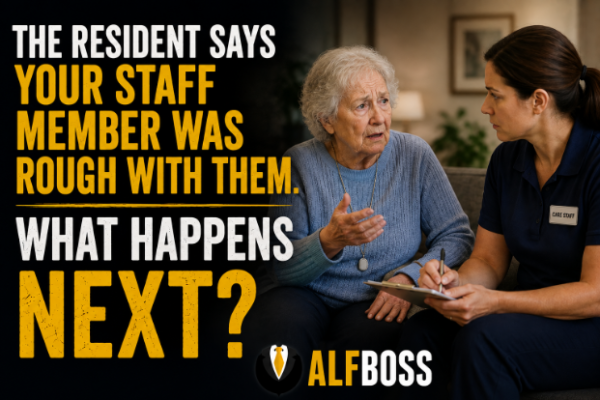
THE RESIDENT SAYS YOUR STAFF MEMBER WAS ROUGH WITH THEM. WHAT HAPPENS NEXT?
Florida ALF Resident Complaints, Resident Rights, and What Administrators Should Do When a Staff Member Is Accused
A resident comes to you and says:
“She was rough with me when she helped me get dressed this morning.”
Maybe the employee has worked for you for years.
Maybe you’ve never had a complaint about them.
Maybe the employee immediately tells you:
“That’s not what happened.”
Or perhaps the resident has dementia, and you’re not sure exactly what occurred.
What do you do?
One thing you should not do is immediately dismiss the complaint.
When a resident says a staff member handled them roughly, yelled at them, threatened them, hurt them, or otherwise treated them inappropriately, you may be dealing with more than a personality conflict.
You could potentially be dealing with a resident-rights issue, suspected abuse or neglect, and possibly a reportable event.
At the same time, taking an allegation seriously does not mean automatically assuming the employee is guilty.
The facility needs a system that protects the resident, treats the employee fairly, follows applicable reporting requirements, and documents what happened.
START WITH THE RESIDENT’S RIGHTS
Rule 59A-36.007, F.A.C. — Resident Care Standards
Florida assisted living facilities are required to respect residents’ rights.
Rule 59A-36.007 addresses resident care standards, and AHCA identifies compliance with resident rights under Section 429.28, Florida Statutes, as an important quality-of-care standard.
How residents are treated matters.
So when a resident complains about how a staff member treated them, the complaint should be taken seriously.
That doesn’t mean you’ve already decided the employee did something wrong.
It means you have a responsibility to respond appropriately.
DON’T START BY DEFENDING THE EMPLOYEE
This can be difficult, especially when the allegation involves an employee you know and trust.
A resident tells you:
“She grabbed my arm really hard.”
Your immediate thought may be:
“Maria would never do that.”
Maybe she didn’t.
But that’s something you determine after looking into the allegation—not before.
Likewise, don’t immediately assume:
“The resident said it, therefore the employee did it.”
Your job at this point isn’t to choose a side.
Your job is to protect the resident and determine what happened as objectively as possible.
FIRST QUESTION: IS THE RESIDENT SAFE RIGHT NOW?
Before worrying about paperwork, ask the most important question:
Is the resident safe?
Look at the resident.
Speak with them privately when appropriate.
Do they appear frightened?
Are they complaining of pain?
Is there redness, bruising, a skin tear, or another injury?
Do they need medical attention?
Is the accused employee still providing care to that resident?
Could another resident potentially be at risk?
Your immediate response should focus on resident safety while the allegation is being evaluated.
You shouldn’t wait until an investigation is finished before deciding whether immediate protective measures are necessary.
LISTEN TO WHAT THE RESIDENT ACTUALLY SAYS
Don’t put words in the resident’s mouth.
There’s an important difference between asking:
“Tell me what happened.”
and asking:
“Did Maria grab you and hurt your arm?”
Allow the resident to describe what happened in their own words as much as possible.
Document what the resident reports.
Depending on the circumstances, you may want to document:
- When the alleged incident occurred
- Where it happened
- Who was involved
- What the resident says occurred
- Whether anyone else was present
- Whether the resident reports pain
- Any visible injuries or findings
- Any other immediate concerns
You aren’t trying to conduct a courtroom interrogation.
You’re trying to understand what was reported so the facility can respond appropriately.
“THE RESIDENT HAS DEMENTIA” IS NOT A REASON TO IGNORE THE COMPLAINT
This deserves special attention.
A resident’s cognitive impairment does not automatically make an allegation meaningless.
Maybe the resident can’t remember the employee’s name.
Maybe the details change.
Maybe they’re confused about when something happened.
That doesn’t mean the facility should automatically dismiss the concern.
Look at the other information available to you.
Who was assigned to the resident?
Who provided the care?
Were other employees nearby?
Did anyone witness the interaction?
Is there an unexplained injury?
Is there relevant documentation?
Have there been previous concerns involving this employee?
Have other residents made similar complaints?
The appropriate response is to evaluate the concern—not simply dismiss the person making it.
SPEAK WITH THE EMPLOYEE — BUT DON’T STOP THERE
The employee should have an opportunity to explain what happened.
There may be another explanation.
Perhaps the resident lost their balance during a transfer.
Maybe the resident resisted care.
Maybe the employee was attempting to prevent the resident from falling.
Maybe another staff member witnessed the entire interaction.
Or perhaps the employee acknowledges that they became frustrated or handled the situation improperly.
Whatever the explanation, don’t make one person’s statement the entire investigation.
Gather the information reasonably available to you.
That may include:
- Speaking with the resident
- Speaking with the employee
- Interviewing witnesses
- Reviewing staff assignments
- Reviewing relevant documentation
- Looking at any reported or observed injury
- Reviewing other information that may help establish what occurred
Then document what you did.
YOUR FACILITY SHOULD HAVE A GRIEVANCE PROCEDURE
Florida’s ALF regulations require facilities to maintain a grievance procedure for receiving and responding to resident complaints and recommendations.
Your grievance procedure shouldn’t exist only because the regulation says you need one.
Staff should actually know how to use it.
Ask yourself:
Who receives resident complaints?
Who needs to be notified?
How is the complaint documented?
Who follows up?
How does the facility document its response?
If your entire system depends on the administrator being physically present when a complaint occurs, you may need a better system.
WHEN DOES A COMPLAINT BECOME SUSPECTED ABUSE OR NEGLECT?
This is where administrators need to be particularly careful.
A resident saying:
“She was rough with me.”
doesn’t automatically establish exactly what happened.
But if the information gives rise to suspected abuse, neglect, or exploitation, don’t treat it as merely an internal employee complaint.
Florida’s regulatory framework requires abuse, neglect, or exploitation to be reported as required under Chapter 415, Florida Statutes.
An internal investigation doesn’t replace an external reporting obligation when one applies.
This distinction is extremely important.
Don’t assume you can investigate the allegation first, determine whether you personally believe it happened, and only then decide whether to make a required report.
The applicable reporting requirements concern suspected abuse, neglect, or exploitation—not simply allegations that the facility has already proven.
DOES IT ALSO MEET THE REQUIREMENTS OF A REPORTABLE ADVERSE INCIDENT?
Depending on what allegedly occurred and the circumstances surrounding it, the situation may also need to be evaluated under Florida’s adverse-incident reporting requirements.
Not every resident complaint automatically becomes a reportable adverse incident.
But when a serious allegation is made, the administrator or person in charge should ask:
Does this situation meet the applicable definition of a reportable adverse incident?
Don’t wait several days for someone to eventually review the paperwork.
Make that determination promptly and follow the applicable reporting requirements when they apply.
DOCUMENT WHAT THE FACILITY DID
Imagine AHCA receives a complaint three weeks later.
A surveyor walks into your facility and asks:
“What did you do when the resident reported this?”
You don’t want your answer to be:
“We handled it.”
Your documentation should demonstrate how the facility responded.
Depending on the circumstances, your documentation may include:
- The resident’s complaint
- Date and time the facility became aware of it
- Immediate observations
- Any reported or observed injury
- Steps taken to protect the resident
- Individuals notified
- Witness information
- Employee statements
- Relevant records reviewed
- Medical evaluation or treatment, when applicable
- Required external reports, when applicable
- Findings from the facility’s review or investigation
- Corrective or protective measures taken
Good documentation helps demonstrate that the facility took the concern seriously and responded appropriately.
WHAT IF THE ALLEGATION ISN’T SUBSTANTIATED?
This is the part administrators sometimes don’t think about until they’re actually dealing with it.
You took the resident seriously.
You protected the resident.
You gathered the available information.
You spoke with the employee and witnesses.
You followed your policies.
If the circumstances required an outside report, you made it.
Then, after reviewing everything available, the allegation is not substantiated.
Now you have another issue to manage.
You may have a good employee sitting in your office thinking:
“I’ve worked here for five years. Why didn’t you believe me?”
This is where leadership becomes extremely important.
INVESTIGATING DOESN’T MEAN YOU DECIDED THE EMPLOYEE WAS GUILTY
Make that distinction clear to the employee.
You can explain:
“When a resident makes a serious allegation involving their safety or treatment, I have a responsibility to take it seriously. Investigating the complaint doesn’t mean I decided you did something wrong. It means I had a responsibility to the resident, to you, and to the facility to determine what happened and follow the required process.”
That conversation can make a tremendous difference.
A good employee needs to understand that the facility’s investigation wasn’t necessarily a statement about their character, integrity, or previous job performance.
The facility was responding to a serious concern in the manner expected of it.
WHAT IF YOU HAD TO MAKE A DCF REPORT?
This can create even more tension.
An employee may understandably ask:
“You called DCF on me when I didn’t do anything?”
Administrators need to understand—and explain—the difference between making a required report based on suspected abuse or neglect and making a finding that the employee committed abuse or neglect.
Those are not necessarily the same thing.
When applicable reporting requirements are triggered, making the report does not itself mean the facility has determined:
“This employee abused a resident.”
It means a concern was reported through the appropriate process.
This distinction matters.
Don’t avoid a legally required report simply because you’re worried about upsetting a good employee.
But also don’t treat the fact that a report was made as proof that the employee committed misconduct.
DON’T PUNISH SOMEONE SIMPLY BECAUSE AN ALLEGATION WAS MADE
The information gathered during the investigation and any applicable outside findings should guide what happens next.
If an allegation isn’t substantiated, don’t allow the employee to become unofficially known as:
“The caregiver who abused that resident.”
Protect confidentiality.
Discourage workplace gossip.
Don’t unnecessarily discuss the allegation with employees who don’t need to know about it.
And don’t treat an allegation itself as proof of misconduct.
At the same time, continue monitoring resident care and take any future concerns seriously.
Fairness works both ways.
AN UNSUBSTANTIATED ALLEGATION DOESN’T AUTOMATICALLY MEAN THE RESIDENT LIED
This is equally important.
If you cannot substantiate an allegation, that doesn’t necessarily mean:
“The resident made the whole thing up.”
Sometimes there simply isn’t enough information to determine exactly what occurred.
A resident with cognitive impairment may genuinely remember or perceive an interaction differently.
The resident should still feel safe reporting future concerns.
Staff should never say things like:
“Nobody believed you last time.”
or
“Here we go again.”
You want residents to continue speaking up when something doesn’t feel right.
THE GOAL ISN’T TO PICK A SIDE
When the allegation first comes in, don’t turn the situation into:
RESIDENT VS. EMPLOYEE.
Your responsibility is to:
Protect the resident.
Preserve the integrity of the investigation.
Treat the employee fairly.
Follow applicable reporting requirements.
Document what happened and what you did.
Let the information you gather guide what happens next.
If the allegation isn’t substantiated, appropriately close the loop with the employee.
A good employee should be able to leave that conversation understanding:
“My administrator didn’t assume I was guilty. They did what they were supposed to do when a resident raised a serious concern.”
DON’T RETALIATE AGAINST THE RESIDENT FOR COMPLAINING
There is also a cultural issue facilities need to watch carefully.
A resident should never become known among staff as:
“The complainer.”
Staff shouldn’t become colder toward them.
They shouldn’t avoid them.
They shouldn’t talk negatively about them because they complained.
And a resident should never feel that speaking up is going to make their life harder.
If residents become afraid to tell management when something is wrong, you have a much bigger problem than a complaint log.
You have created an environment where serious problems may remain hidden.
TRAIN YOUR STAFF BEFORE THIS HAPPENS
This isn’t something employees should learn for the first time after an allegation occurs.
Florida’s ALF training requirements address resident rights and recognizing and reporting resident abuse, neglect, and exploitation for applicable staff.
Your employees should know what to do if they witness or suspect inappropriate treatment of a resident.
They shouldn’t stay quiet because the employee involved is their friend.
They shouldn’t decide on their own that the resident is confused.
And they shouldn’t assume someone else will report it.
They should know your facility’s procedures and follow them.
PASCAL’S COMPLIANCE TIP: GIVE YOUR STAFF THIS SCENARIO
At your next staff meeting, ask:
“A resident tells you another caregiver grabbed them roughly this morning. What do you do?”
Then stop talking.
Listen to the answers.
If your employees aren’t sure who to notify…
If someone says:
“I’d ask the caregiver if they really did it first.”
If someone says:
“That resident complains about everybody.”
Or nobody knows where your abuse-prevention or grievance procedures are…
You just identified a training opportunity.
It’s much better to discover that during a staff meeting than during an actual allegation.
THE BIGGEST MISTAKE IS DECIDING TOO EARLY THAT “NOTHING HAPPENED”
Maybe your investigation ultimately doesn’t substantiate the allegation.
That can happen.
But there is a major difference between:
“We took the allegation seriously, protected the resident, gathered the available information, followed applicable reporting requirements, treated the employee fairly, and documented our findings.”
and:
“We know that employee. She would never do that.”
One is a compliance system.
The other is an assumption.
THE BOTTOM LINE
When a resident tells you a staff member was rough with them, don’t immediately decide whether you believe the resident or the employee.
Instead:
Protect the resident.
Listen to what the resident reports.
Document the allegation.
Gather the available information.
Follow your grievance and abuse-prevention procedures.
Determine whether mandatory reporting or adverse-incident reporting requirements apply.
Treat the employee fairly while the allegation is being evaluated.
Document your response and findings.
And if the allegation isn’t substantiated, remember that investigating it did not mean you accused your employee of being guilty.
It meant you took a resident’s concern seriously and followed the appropriate process.
Because if AHCA receives the complaint later, one of the most important questions may not simply be:
“What did the employee do?”
It may be:
“WHAT DID THE FACILITY DO WHEN IT FOUND OUT?”
REGULATIONS AND STATUTES REFERENCED
Rule 59A-36.007, Florida Administrative Code — Resident Care Standards
Rule 59A-36.011, Florida Administrative Code — Staff Training Requirements
Rule 59A-36.015, Florida Administrative Code — Records / Grievance Procedure
Section 429.28, Florida Statutes — Resident Bill of Rights
Chapter 415, Florida Statutes — Abuse, Neglect and Exploitation Reporting Requirements