
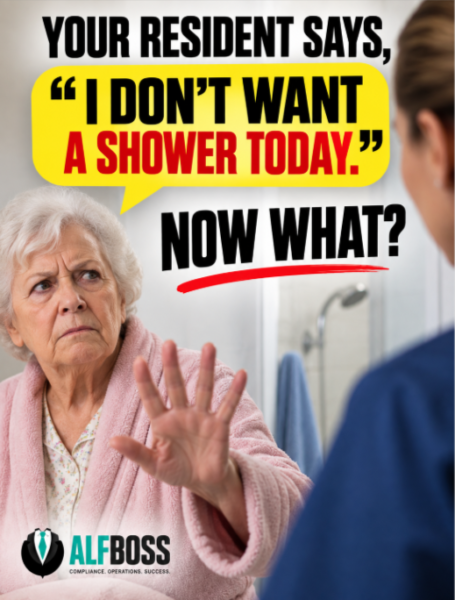
YOUR RESIDENT SAYS, “I DON’T WANT A SHOWER TODAY.” NOW WHAT?
Resident Rights Don’t Disappear Just Because Someone Lives in an ALF
It’s shower day.
Your caregiver goes into the resident’s room and says it’s time to get ready.
The resident responds:
“No. I don’t want a shower today.”
What happens next?
Does the caregiver insist because the resident is scheduled for a shower?
Does the facility call the family?
Does the resident get documented as “noncompliant”?
Or does the employee simply walk away and forget about it?
This seems like a small everyday situation.
But it brings together two important responsibilities in assisted living:
Respecting resident rights while still providing appropriate care and supervision.
START WITH THE RESIDENT’S RIGHTS
Florida assisted living residents do not give up their personal rights when they move into an ALF.
Section 429.28, Florida Statutes — Resident Bill of Rights provides important protections concerning dignity, privacy, autonomy, participation in decisions, and treatment within an assisted living facility.
Official statute:
A resident saying:
“I don’t want a shower right now.”
shouldn’t automatically turn into a confrontation between the resident and the caregiver.
Your staff should understand that assisted living is not about forcing residents through a facility schedule.
BUT DON’T JUST WALK AWAY EITHER
This is where the other side of the issue matters.
The facility still has resident-care responsibilities.
Under Rule 59A-36.007, F.A.C. — Resident Care Standards, facilities are responsible for providing appropriate personal supervision and assistance with activities of daily living based on residents’ needs.
Official regulation:
https://flrules.org/gateway/ruleno.asp?id=59A-36.007
So when a resident refuses a shower, the answer shouldn’t necessarily be:
“Okay.”
And then nobody thinks about it again.
Instead, staff should try to understand what is happening.
FIND OUT WHY
There could be many reasons a resident doesn’t want to shower.
Maybe they don’t want one right now.
Maybe they don’t like the caregiver assisting them.
Maybe they’re cold.
Maybe they’re embarrassed.
Maybe they’re tired.
Maybe they’re experiencing pain.
Maybe they’re confused.
Maybe they prefer bathing at a different time of day.
Maybe something has changed.
You don’t necessarily need to turn every refused shower into an investigation.
But there is a big difference between:
“Mrs. Smith refused her shower.”
and:
“Mrs. Smith doesn’t normally refuse care. Why is she refusing today?”
That second question is where good resident care begins.
TRY AGAIN LATER
Sometimes the simplest solution is also the best one.
The resident doesn’t want a shower at 8:00 a.m.?
Try again later.
Maybe another caregiver has a better relationship with the resident.
Maybe the resident would prefer to shower after breakfast.
Maybe they would rather bathe in the evening.
Whenever possible, work with the resident instead of immediately turning the situation into a battle.
The goal should be to provide the needed care while preserving the resident’s dignity and choices.
ONE REFUSAL IS DIFFERENT FROM A PATTERN
This is where administrators need to pay attention.
A resident refusing one shower is one thing.
A resident refusing bathing repeatedly for several days or longer can become something very different.
Now you may have a resident-care issue.
Are hygiene needs being met?
Is there a new behavioral or cognitive issue?
Is the resident experiencing pain?
Has something changed physically or emotionally?
Is there a particular staff member the resident doesn’t want assisting them?
Does the resident’s care need to be reassessed?
A repeated refusal shouldn’t simply become:
“That’s just what she does.”
Patterns matter.
DON’T LABEL THE RESIDENT “NONCOMPLIANT”
I would be careful with this language.
“Resident noncompliant with shower.”
What does that actually tell us?
Not much.
It can also make the situation sound like the resident did something wrong simply by expressing a preference or refusing care.
Better documentation tells the story.
For example:
Resident declined scheduled shower this morning, stating she was tired and preferred to shower after lunch. Resident offered shower again at 1:30 p.m. and accepted assistance.
Now we understand what happened.
If the resident continues refusing, document those refusals and the actions staff took in response.
WHAT IF THE FAMILY SAYS, “MAKE HER SHOWER”?
Now the situation becomes interesting.
The family may be frustrated.
They may say:
“She hasn’t showered. Just make her do it.”
But family frustration doesn’t erase the resident’s rights.
Explain what the facility is doing.
Tell them staff are continuing to offer assistance.
Explain any patterns you’re seeing.
Discuss alternative approaches.
And when appropriate, involve the resident’s healthcare provider or other appropriate professionals if the repeated refusal may indicate a change in the resident’s condition or needs.
The goal isn’t to choose between the family and the resident.
The goal is to address the resident’s needs appropriately while respecting the resident as a person.
PAY ATTENTION WHEN SOMETHING CHANGES
This is especially important with a resident who normally accepts assistance.
If Mrs. Smith has happily showered three times a week for the past two years and suddenly begins refusing:
Pay attention.
The refusal itself may not be the real issue.
Something else may have changed.
Rule 59A-36.007(1), F.A.C. requires personal supervision that includes awareness of the resident’s general health, safety, and physical and emotional well-being.
A change in behavior can sometimes be information.
Don’t automatically dismiss it as the resident being difficult.
DOCUMENT WHAT ACTUALLY HAPPENED
Your documentation should be factual.
Depending on the circumstances, document:
- What care was offered.
- That the resident declined.
- What the resident said, when relevant.
- Whether another option or different time was offered.
- Whether the resident later accepted the care.
- Repeated refusals or developing patterns.
- Significant changes observed.
- Notifications made when appropriate.
- Actions taken by the facility.
Don’t document something that didn’t happen.
And don’t chart:
“Resident refused.”
day after day without anyone eventually asking:
“What are we doing about this?”
HOW TO STAY COMPLIANT
Train your staff to understand both sides of this issue:
- Respect the resident’s dignity, privacy and choices.
- Don’t physically force routine personal care simply because it’s on the schedule.
- Ask why the resident is refusing when appropriate.
- Offer reasonable alternatives, including trying again later.
- Watch for patterns of repeated refusal.
- Pay attention when a resident’s normal behavior changes.
- Document refusals factually.
- Notify the appropriate people when repeated refusal creates a resident-care concern or reflects a significant change.
- Make sure the resident’s actual care needs continue to be addressed.
THE BOTTOM LINE
A resident says:
“I don’t want a shower today.”
Don’t turn it into a fight.
But don’t automatically forget about it either.
Respect the resident’s decision.
Find out what’s going on.
Try again.
Offer alternatives.
Document what happened.
And if it becomes a pattern, pay attention.
Because good assisted living isn’t about getting every resident through the same checklist at the same time every day.
It’s about providing the care they need while remembering something very important:
THEY LIVE THERE.
IT’S THEIR HOME.
And they still have a voice in how they live their life.
OFFICIAL RESOURCES
Rule 59A-36.007, F.A.C. — Resident Care Standards
https://flrules.org/gateway/ruleno.asp?id=59A-36.007
Section 429.28, Florida Statutes — Resident Bill of Rights
https://www.leg.state.fl.us/statutes/index.cfm?App_mode=Display_Statute&URL=0400-0499/0429/Sections/0429.28.html